

Showing the single result
Victorinox knives for home and professional use. At Macys Digital Tenerife we help you choose the right knife for the cut you make, the type of food and the ergonomics you are looking for. Filter by type of knife, sheet length y collection to get it right the first time.
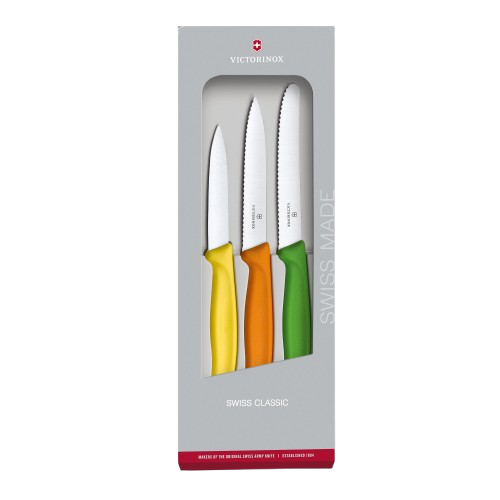
Victorinox Knife Set Swiss Classic
Out of stock
-
- 1 straight peeling knife (straight edge, ~8 cm).
- 2 serrated/serrated peeling knives (~8 cm each, ideal for tomatoes, soft-skinned fruits and vegetables).
- Blade materialHigh carbon stainless steel (high edge retention, corrosion resistant, precise cutting edge).
- HandlesPolypropylene (PP) ergonomic, non-slip, yellow/orange/blue (or multicoloured variations), hygienic and comfortable.
- Blade lengthApprox. 8 cm (3.15 inches) each knife.
- FeaturesStraight and serrated edge for versatility, dishwasher safe, no need for frequent sharpening, classic Swiss design.
Victorinox knives: precision, ergonomics and an edge designed for everyday use.
At Macys Digital Tenerife we know that the “perfect” knife is not the most expensive or the most eye-catching: it is the one that adapts to your kitchen, The cut is controlled and comfortable for you every day. That's why we work this section of Victorinox knives with criteria: models designed for domestic use as well as options that are highly valued in professional environments for their balance, performance and practicality.
Victorinox is world-renowned for its functional approach: well-designed tools, reliable materials and a manufacturing consistency that shows in use. In cutlery, that translates into knives that strike the ideal balance between good edge, comfortable operation y reasonable maintenance.
Here you can choose knives by type of task, sheet length and handling preferences (handle, weight, format). If you buy methodically, you get it right the first time and avoid the typical drawer full of knives that “don't work”.
How to choose your Victorinox knife (the method we recommend)
1) Start with your “main knife”.”
If you could only have one, it would almost always be one of these two:
Chef's knife (cook)
It is the most versatile: vegetables, meat, chicken, herbs, long cuts... Ideal if you like the rocking motion when chopping.
Recommended if: you want an all-rounder for the task 80%.
Santoku
Similar in versatility, but with a straighter profile. Usually very good for fine cuts and precision in vegetables.
Recommended if: you prefer more “linear” cuts and board control.
👉 Our practical recommendation: choose first chef or santoku and then complete with 1-2 specific knives.
2) Complete with the “must-haves” according to your cuisine
Puntilla / peeler (small blade)
For fruit, peeling, short cuts and precision. The second most frequently used knife at home.
Bread knife (serrated)
If you buy crusty bread, pastries or very ripe tomatoes, sawing makes a difference.
Carving / filleting
For long and thin cuts (roast meats, cooked ham, fish according to format).
Boning
If you work with meat frequently (chicken, ribs, bone-in cuts), it is the right tool and improves control.
Multi-purpose knife
That middle ground between a lace and a chef: very useful if you cook fast and want to be agile.
3) Choose the leaf length with a simple criterion
- Short blade (precision): more control in the hand, ideal for fine tasks.
- Medium blade (versatility): the balance for the majority.
- Long blade (clean cuts): best for large pieces, slicing and long cuts without “sawing”.
👉 Quick rule of thumb: if your board is small or your space is limited, a very long blade can get in the way rather than help.
What to look for in a good Victorinox knife (expert criteria)
Ergonomics of the handle
A good handle gives you safety: control, stable grip and less fatigue. If you do a lot of cooking, this matters as much as the sharpness. At Victorinox you'll find styles from classic handles to professional-style options with great grip.
Balance and control
The knife should not “pull” too much on the tip or the handle. The balance is noticeable when you make repeated cuts: you work faster and more comfortably.
Type of cutting edge
- Smooth edge: the most common for most foods (clean cut).
- Serrated: bread, ripe tomato, rinds; cut without crushing.
Recommended selections by user type
If you want a practical set (without complication)
- 1 knife chef or santoku
- 1 lace
- 1 serrated bread
With this you cover practically all your daily cooking.
If you cook a lot and want to level up
- Chef/Santoku (according to preference)
- Puntilla
- Serrated bread
- Carving or filleting knife (depending on what you cook)
- Deboning (if you work with bone-in meat)
If you are looking for a “pro” approach”
It often makes sense to prioritise ergonomics and specific knives for repetitive tasks (boning, filleting, carving) in addition to the main chef.
Maintenance and sharpening: how to maintain performance
At Macys Digital Tenerife We insist on this because it totally changes the experience:
- Wash and dry after use (especially if salt, acids or moisture are present).
- Avoid cutting on surfaces that “kill” the cutting edge (wooden board or other suitable material is better).
- To maintain the cutting edge: a sharpening steel or a sharpener quality according to your custom.
- When the knife no longer recovers: deeper sharpening (stone/service).
👉 A good knife is not the one that “never needs to be sharpened”, but rather the one that remains easy and responds well to sharpening.
Kitchen safety (brief, but important)
- Always cut with a stable board and a “clawed” hand to protect your fingers.
- Do not use a dull knife: paradoxically, it is more dangerous because it forces you to use force.
- Proper storage (block, sheath or magnet) to protect blade and hands.
FAQ for the section “Victorinox knives”.”
Which Victorinox knife do you recommend first?
A chef (o santoku if that is more convenient for you) + a lace. This is the most useful combination.
Is it worth buying a bread knife?
Yes if you eat crusty bread or foods that are flattened with a smooth edge (very ripe tomatoes). Sawing is a “holy hand”.
Which blade length is best?
It depends on your board and your hand: medium blade is usually the balance point. If you cook larger pieces, consider a longer blade.
How do I know which one to choose between two similar models?
Decide by: 1) type of cutting you do, 2) length, and 3) handle/ergonomics. If the grip doesn't suit you, it won't be your ideal knife.


