





Insta360 vs GoPro 2026: The Definitive Guide to Choosing

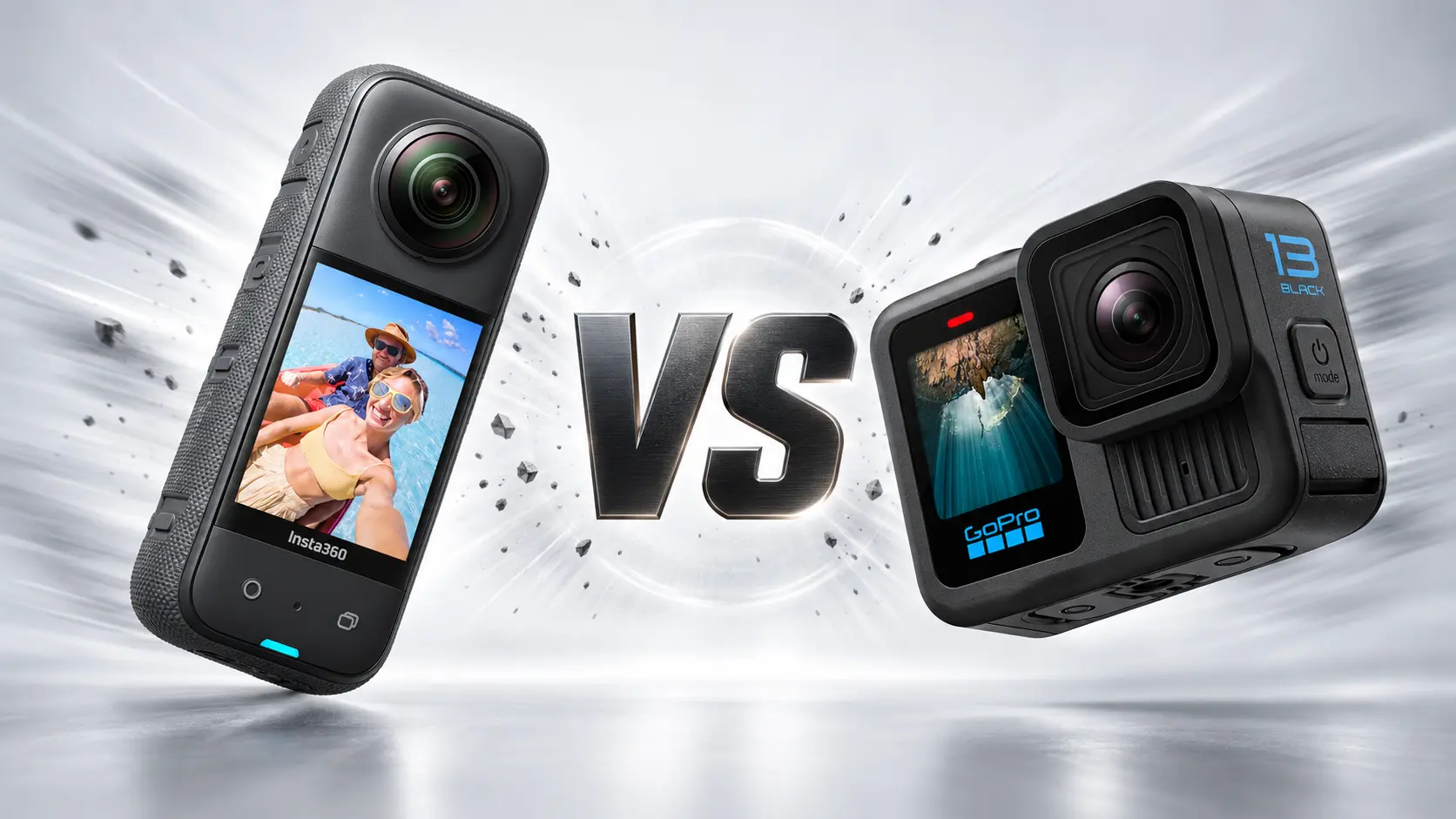
Insta360 or GoPro? There’s no absolute winner: on Reddit, one user says Insta360 “is a better camera,” and another replies they’d take their GoPro “9 times out of 10.” Both are right, because they’re talking about different uses. In this guide we’ll help you decide based on yours.
Both brands dominate the action camera market, but they start from a different idea: Insta360 bets on the 360° format with after-the-fact reframing, GoPro on the classic first-person point of view with the most polished stabilization in the industry. That difference in approach, more than any spec sheet, is what should really guide your purchase.
We compare Insta360 vs GoPro on design, stabilization, image quality, durability, apps, and social media. At the end we tell you which one suits you based on your use case, and which specific model from each brand to look at.
Insta360 vs GoPro: key differences at a glance
| Criteria | Insta360 | GoPro |
| Format | 360° (post-shoot reframing) and POV models (X4 Air, GO) | Classic POV, fixed wide angle |
| Stabilisation | Reframing and editing without needing to aim well | HyperSmooth, the industry’s historical benchmark |
| Strength | Reencuadre y edición sin necesitar apuntar bien | Calidad de imagen y flujo de postproducción más simple |
| Water resistance | Up to 15 m without a case on models like the X5¹ | Up to 5 m without a case on models like the Max¹ |
| 360° battery life | Up to 135 min recording 5.7K at 30 fps on the X4¹ | Varies by model, benchmark in the Hero line |
| Typical use | Motorcycling, travel, creative content, social media | Action sports, surfing, diving, mountain biking |
| App ecosystem | Insta360 app, automatic editing with reframing | GoPro Quik, integration with GoPro Cloud |
Submersibility and battery life figures per specialized technical sources (shotkit.com) — check the exact model in the official specs from Insta360 and GoPro, as they vary by generation.
Design and format: 360° vs. classic point of view
The most important difference between Insta360 and GoPro isn’t image quality, it’s format. Insta360’s 360° cameras (like the X4 or X5) record in all directions at once, and you decide the framing afterward, in the app or on your phone. That frees you from aiming well in the moment, which is very useful on a motorcycle, a bike, or whenever you’re wearing the camera and can’t keep track of the angle.
GoPro, on the other hand, records at a single, very wide, fixed angle, like a traditional action camera. There’s no reframing afterward, but you don’t need it either: you point and shoot, with no extra editing steps. That’s exactly what the Reddit user who prefers GoPro values: a simpler workflow, without having to “move the camera” later.
Insta360 also has models that drop the 360° format for a more compact, lightweight design, aimed at vlogging and at anyone who wants a small camera without losing stabilization. And they’re not the only brands in this space: DJI, with its Osmo line, is the third usual reference point when someone compares action cameras if you’re torn between all three, the decision criteria are the same we give here for Insta360 and GoPro: define your use case first, not the brand.
Standout models within each brand
Not every Insta360 is the same, and neither is every GoPro. Before deciding on a brand, it’s worth looking at which specific model fits your budget and use case:
- Insta360 X5 — the brand’s high-end 360° model, with the best submersibility in the Insta360 catalog without an extra case. It’s the one to look at if you want maximum reframing flexibility and don’t mind paying for the top tier.
- Insta360 X4 — the sweet spot between price and performance within the 360° line, with good recording battery life. It’s the sensible entry point if you want to try the 360° format without going straight for the top tier.
- GoPro Hero 13 — the brand’s classic POV benchmark, with the most mature accessory ecosystem: harnesses, poles, remotes, and cases designed specifically for action sports.
We have dedicated reviews of the Insta360 X5 and the GoPro Hero 13 with more technical detail on each, if you want to dig deeper before deciding. If your budget is tighter, ask us about the X4: it covers most use cases without the high-end price tag.
Image stabilization
This is where the two brands are very evenly matched. GoPro popularized HyperSmooth and it’s still a benchmark: footage stays practically vibration-free even while running or mountain biking. Insta360 answers with FlowState, which in practice delivers a comparable result and, in the case of the 360° models, has an added advantage: since it records the whole surrounding environment, automatic reframing corrects sudden movements that a fixed-angle camera can’t disguise the same way.
For normal use (travel, motorcycling, recreational sports) either brand will give you stable footage. The difference shows up in extreme conditions, where it’s worth checking the specific model’s spec sheet before deciding.
Image quality and resolution
This is where the Reddit user who prefers GoPro has a real point: for fixed-angle footage, many advanced users perceive better image quality on GoPro, with more consistent color processing. Insta360, on the other hand, has to split its resolution across the two lenses that capture the 360° view, which, for an equivalent sensor, can mean less detail per reframed area — although its latest models have closed that gap considerably. The Insta360 X5, for example, records 360° video at resolutions that were unthinkable in this format just two generations ago.
What about low light?
Low-light conditions are where the format difference shows up the most. GoPro, by concentrating all of the sensor’s resolution on a single angle, tends to hold on to more detail indoors or at dusk. Insta360 can lose a bit more sharpness in those conditions on its 360° models, although the brand’s POV models (built for a single angle, like the vlogging line) don’t carry that disadvantage.
If you mostly shoot at night or indoors in low light, this is the criterion that should weigh the most in your decision more than the brand itself.
Durability and outdoor use
Both brands are built for knocks, water, and dust, but with nuances. GoPro has a reputation for tough, no-nonsense durability: it’s the camera surfers and divers choose because it withstands submersion without an extra case on most of its recent models up to 5 meters on models like the Max, according to available technical specs. Insta360 is also water-resistant across its action line in fact, on models like the X5, submersibility without a case reaches up to 15 meters, beating some GoPros on that specific figure. Either way, always check the maximum depth the exact model supports before taking it into the sea, since it varies from one generation to the next.
If your main use is water sports or contact sports (surfing, motocross, climbing), GoPro starts with a historical and ecosystem advantage in that space: harnesses, poles, and mounts designed specifically for those sports have been on the market for longer. If your use is more about travel, motorcycling, or creative content, that advantage matters less.
App ecosystem and editing
Both apps have improved a lot and are now a central part of the decision, not an afterthought. Insta360’s app stands out for automatic editing: it recognizes the best moments, applies reframing, and, with the 360° models, lets you “move the camera” after recording — something no GoPro can do, because it never captured that angle in the first place.
GoPro Quik also edits automatically and integrates with GoPro Cloud to upload footage without cables. If you already own GoPro accessories (remotes, poles, harnesses), the brand’s ecosystem is broader thanks to its longer time on the market. DJI, the sector’s third brand, has its own app (DJI Mimo) with a similar assisted-editing approach, in case the comparison comes down to all three for you.
Insta360 or GoPro for social media
For content made specifically for Instagram, TikTok, or YouTube Shorts, Insta360 usually wins out: post-shoot reframing lets you pull several vertical clips from a single 360° recording, without having to reshoot the scene from another angle. It’s the biggest practical difference if your goal is publishing a lot of content with little editing time.
GoPro doesn’t fall behind on final clip quality, but it demands more foresight: if you didn’t aim well in the moment, no reframing will fix it afterward. For anyone who already has an established editing workflow and prioritizes image quality over flexibility, it’s still a solid choice.
At Macys Digital, what tourists and locals who come into the store ask us most isn’t which camera is “better” in the abstract, but how much time they want to spend editing. That question usually decides the purchase more than any spec.
Which one should you choose based on your use?
- You travel and want content without the hassle: Insta360, for the post-shoot reframing. Record first, decide the angle later, without losing the moment because you didn’t aim well.
- You do action sports or water sports: GoPro, for proven durability and the more mature accessory ecosystem for harnesses, helmets, and boards.
- You shoot on a motorcycle: either one works, but Insta360’s 360° format has a concrete advantage: you don’t need to position the camera with millimeter precision, because you reframe afterward.
- Vlogging and content creation for social media: consider Insta360’s more compact models, designed specifically for talking to the camera without needing a separate gimbal, and for pulling several formats from a single take.
- You prioritize image quality and simple post-production: GoPro, according to advanced users on specialized forums.
Price and availability in Tenerife
We’ve been selling electronics in the Canary Islands for over two decades, and with action cameras we see the same pattern every high season: whoever decides on price alone usually ends up switching cameras the following year because it didn’t fit their real use case. That’s why we’d rather you decide on format (360° or POV) and use case first, and then talk to us about the specific model and price.
We have it available at Macys Digital, Tenerife, with warranty included and shipping across the Canary Islands in 24-48h. If you’re also visiting from abroad, buying here has a real price advantage over buying on mainland Spain we explain it in more detail in this guide about buying electronics in the Canary Islands.
Frequently Asked Questions
Which is better, Insta360 or GoPro?
It depends on the use case, there’s no single winner. Insta360 wins on reframing flexibility and social media content; GoPro wins on perceived image quality and post-production simplicity, according to real users on specialized forums.
Insta360 or GoPro for beginners?
Insta360, because post-shoot reframing forgives framing mistakes made in the moment. With GoPro you have to aim well from the start.
Which one holds up better to knocks?
GoPro has a reputation for being more rugged in extreme use, although both brands offer models built for impacts and water — and on specific submersibility figures, some Insta360 models actually go further.
Can I use GoPro accessories on an Insta360?
Some mounting accessories (standard threads) are compatible between brands, but the specific ones (cases, proprietary poles) are not. Check the exact compatibility for your model before buying third-party accessories.
Which one is better for diving?
GoPro starts with a historical and ecosystem advantage in submersion, but always confirm the maximum depth each brand's exact model supports before taking it into the water.
Does Insta360 also work as a "normal" camera?
Yes. Insta360's POV models (not just the 360° ones) record at a single angle like a traditional action camera, with no need to reframe anything afterward.
Is DJI a better option?
DJI is the third reference brand in action cameras, with particular strength in gimbals and stabilization. If you're torn between the three, the criterion is the same: define your use case (travel, sports, social media) before comparing specs.
Have questions about which specific Insta360 or GoPro model suits you? We have it available at Macys Digital, Tenerife, with warranty included. Message us on WhatsApp and we'll help you choose..