





Insta360 X4 vs X5: What Actually Changes

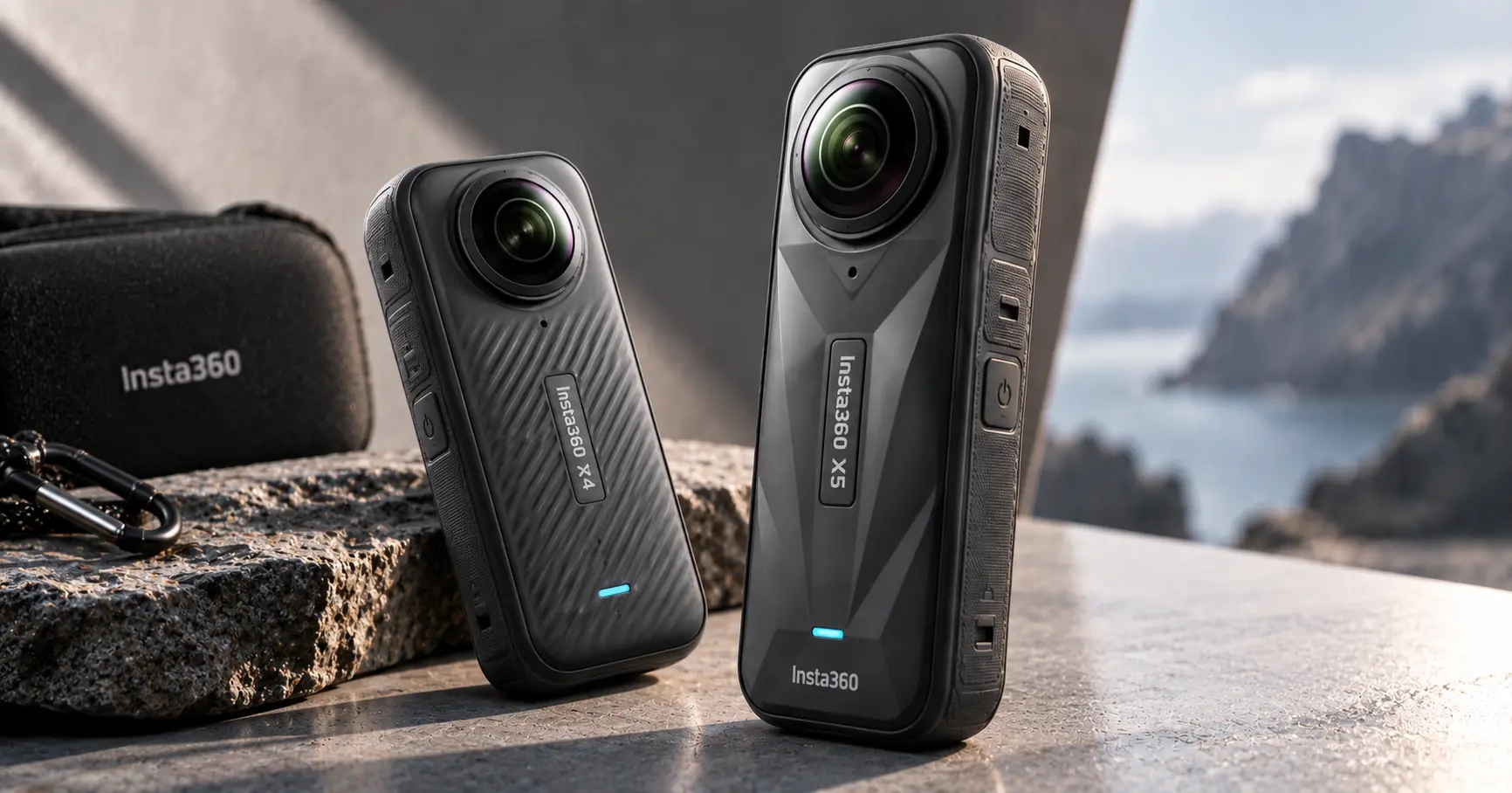
Comparing the Insta360 X4 vs X5 comes down to one real question: does the sensor upgrade justify the price? It's not resolution or design that changes the most between the two cameras — it's the sensor, and it's a bigger difference than it looks on the spec sheet. Here's what actually changes and whether the upgrade is worth it.
Insta360 X4 vs X5: key differences at a glance
| Criteria | Insta360 X4 | Insta360 X5 |
| Sensor | 1/2″ | 1/1.28" — 144% larger¹ |
| Low-light performance | Well | Noticeably better, per official source |
| Battery (8K at 30 fps) | ~60-75 min² | ~75-90 min² |
| Dynamic range | Standard | Higher |
| Accessories | Own lineup | Battery and some cases not compatible with the X4³ |
¹ Official source: Insta360independently confirmed by maisondudrone.com. ² Source: foto321.com — actual battery life varies with resolution and recording conditions. ³ Check exact accessory compatibility before buying separately.
The real difference: the sensor
The Insta360 X5 packs two 1/1.28-inch sensors, 144% larger than the 1/2-inch sensors on the X4 — it's the technical change that matters most between the two cameras. Insta360 itself confirms this in its official comparison, and an independent source arrives at the exact same figure.
A larger sensor isn't just a number on a spec sheet: it captures more light, which translates into less digital noise in low-light conditions and more dynamic range headroom (the gap between the darkest and lightest areas of an image). If you mostly shoot during the day, outdoors, this advantage matters less. If you shoot at night, indoors, or at dusk, it's the main reason to make the jump.
Battery life
The X4 lasts 60 to 75 minutes recording in 8K at 30 fps, according to a specialized source (the same one as the table above). The X5 extends that margin to 75-90 minutes under the same conditions, and the gap grows further at lower resolutions. It's not a huge leap, but if you tend to record long, uninterrupted sessions (a full day on the bike, a long hike), the X5's extra 15-20 minutes could be exactly what you're missing to avoid running out mid-way.
Software and thermal management: what doesn't show up on the sensor spec
The X5 improves on the X4 in noise reduction, audio processing, and thermal management, according to foto321.com's detailed comparison. Thermal management matters more than it seems: a camera that overheats cuts recording on its own to protect itself, which is especially annoying during long summer sessions or when riding a motorcycle in the sun. The X5 also debuts PureVideo, a software feature designed to make better use of the larger sensor during final video processing.
None of these improvements are as visible on a spec sheet as the sensor figure, but in real-world use — especially in the Canary Islands, with high temperatures for much of the year — thermal management is as practical an argument as the sensor itself.
Accessory compatibility
Not all accessories are interchangeable between the two cameras. The X4's battery and some cases aren't compatible with the X5. If you already own X4 accessories and are considering the switch, factor in that extra cost before deciding — it's not just the price of the camera body.
At Macys Digital, this is something people ask us constantly when someone comes in with their X4 wondering about the X5: it's not just "is the new camera worth it," it's "how much of what I already have still works." That's why we prefer to review what accessories you already have with you before recommending the switch.
Is it worth upgrading from X4 to X5?
It depends on whether you're starting from scratch or already own an X4. If you don't have a 360° camera yet, the X5 is the more complete of the two, and the sensor upgrade justifies the price difference for most uses. If you already own an X4 and are happy with it, the jump is more debatable: the improvement is real, especially in low light, but it's not the kind of radical change that forces an immediate upgrade.
As a general rule: upgrade if you record a lot in low-light conditions, if you need every extra minute of battery, or if you're going to push the camera hard every day. If your use is occasional and you already have the X4, you probably won't notice the difference enough to justify the switch.
In-store, we mostly see two profiles: people starting from zero with no 360° camera yet, and people who already have an X4 wondering if the upgrade is worth it. We almost always point the first group straight to the X5; for the second group, we ask them to think first about how often they've wished for more light or more battery before spending on the upgrade.
Which one should you choose based on your use?
- Buying your first 360° camera: X5, no question. The sensor upgrade and software improvements justify starting at the top tier if you're not coming from an earlier model.
- You mostly shoot during the day, outdoors: either one works fine. The X5's sensor advantage matters less in good light.
- You often shoot at night, indoors, or at dusk: X5. This is the scenario where the sensor difference shows the most.
- You record long, uninterrupted sessions (motorcycling, hiking): X5, for the slightly bigger battery and better thermal management.
- You already have an X4 and barely use it: you probably won't notice enough of a difference to justify the cost — stick with the X4 until it wears out.
Frequently Asked Questions
What's the difference between the Insta360 X4 and the X5?
Mainly the sensor: the X5 features sensors that are 144% larger, which improves low-light performance and dynamic range. It also has somewhat longer battery life.
What's the difference between the Insta360 X4 and the X4 Air?
They're different models within the same generation: the X4 Air is a more compact, cheaper variant, not the direct successor. If you're torn between these two instead of between the X4 and X5, the decision criteria are different — ask us and we'll guide you based on your budget.
Can you record while the camera is charging?
Yes, both models allow it, though it's worth keeping an eye on the camera's temperature during long sessions to avoid automatic shutdown from overheating.
What microSD card is recommended?
A high-speed card (Class U3 or higher) to avoid dropping frames when recording in 8K. We'll confirm the exact model for you when you come into the store.
Which is the best Insta360 camera overall?
It depends on your budget and whether you prioritize the 360° format or a more compact vlogging-style camera. You can browse the full Insta360 range available at Macys Digital, and if you're also torn between Insta360 and GoPro as a brand, we have a full comparison between the two..
Not sure if the jump from X4 to X5 is worth it for you, or which one fits your use case better? We have it available at Macys Digital, Tenerife, with warranty included. Message us on WhatsApp and we'll help you decide..